
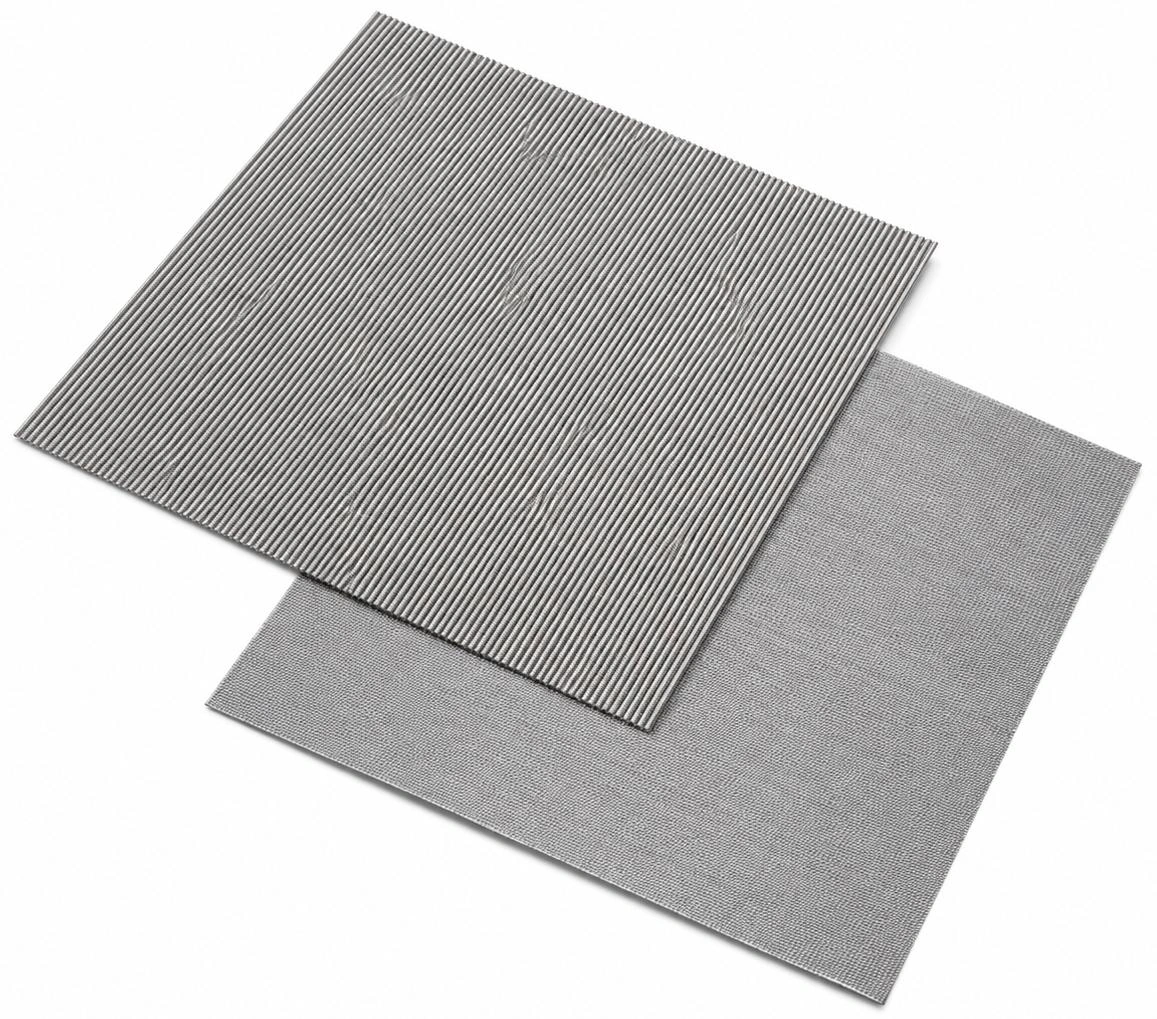
Application and Selection.
Unequal wire counts and diameters form a dense filtration structure. Select both warp and weft specifications; a square mesh aperture formula does not apply.
- Weave families
- Plain Dutch, twilled Dutch and reverse constructions
- Catalogue
- 51 published combinations across four families
- Rating basis
- Confirm retention rating and test method
Catalogue units and nominal retention ratings require confirmation against the selected construction and agreed test method.
Technical Information
Open a section to view the details, tables and illustrations.
Weave Structure & Filtration
Understanding Dutch Weave Mesh
Dutch weave uses unequal wire counts and, typically, unequal wire diameters in the two directions. The densely interlaced wires form filtration passages at their junctions.
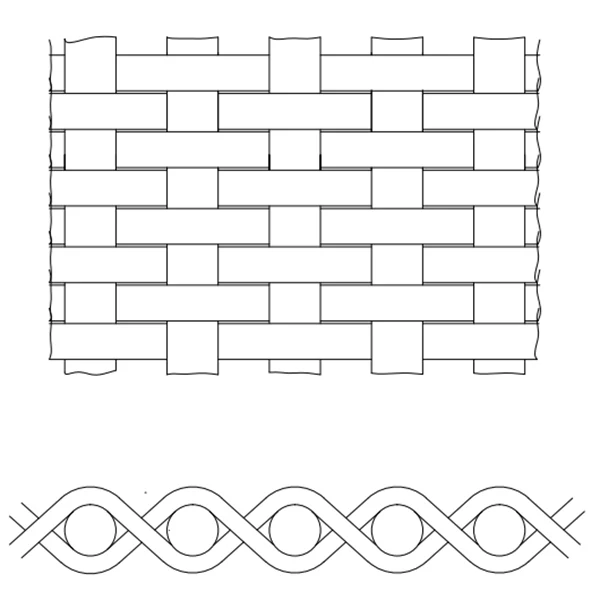
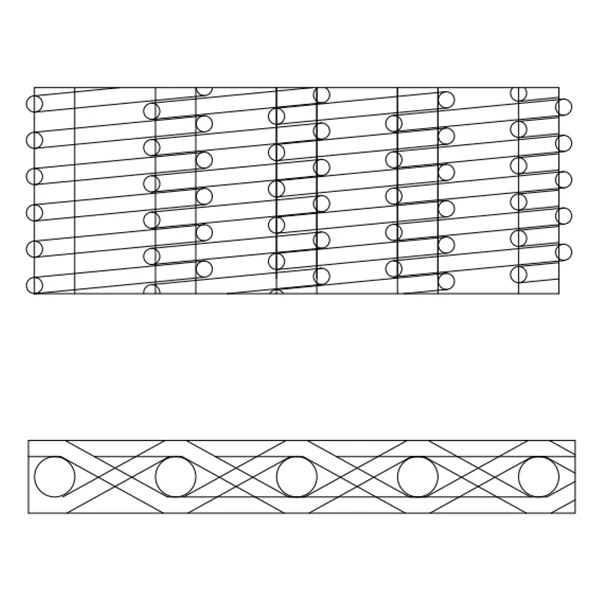
Plain Dutch weave - source schematic | Twilled Dutch weave - source schematic
Weave Family | Interlacing | Typical Wire Arrangement |
|---|---|---|
Plain Dutch (PDW) | 1 over / 1 under | Fewer, thicker warp wires; many fine weft wires. |
Twilled Dutch (DTW) | 2 over / 2 under | Thick warp and closely packed fine weft; diagonal pattern. |
Reverse plain (RPDW) | 1 over / 1 under | Many fine warp wires; fewer, thicker weft wires. |
Reverse twilled (RDTW) | 2 over / 2 under | Reverse wire arrangement with a twilled interlacing. |
Construction descriptions checked against independent mesh manufacturers. Warp runs along the woven length; weft runs across it.
Specify the Rating Basis
Mesh count alone does not define Dutch weave filtration. A square mesh aperture calculation cannot represent its three dimensional passages. Specify the filtration rating, its test method and the required retention performance.
Table convention: mesh counts per inch; wire diameters in mm; nominal filtration in µm. These units are interpreted from standard catalogue convention because the online tables omit unit labels. Confirm units and the rating basis in the final order.
Plain Dutch Weave
Catalogue Specifications — SUS304
Twelve published combinations; nominal filtration values span 32 - 211 µm. Refer to the unit and rating notes above.
MESH COUNT warp × weft | WIRE Ø (mm) warp × weft | Material | NOMINAL FILTRATION (µm) |
|---|---|---|---|
12 × 64 | 0.6 × 0.4 | SUS304 | 211 |
12 × 76 | 0.45 × 0.355 | SUS304 | 192 |
24 × 110 | 0.35 × 0.25 | SUS304 | 97 |
25 × 140 | 0.28 × 0.2 | SUS304 | 100 |
30 × 150 | 0.23 × 0.17 | SUS304 | 82 |
40 × 200 | 0.18 × 0.14 | SUS304 | 63 |
40 × 350 | 0.22 × 0.08 | SUS304 | 75 |
50 × 250 | 0.14 × 0.11 | SUS304 | 50 |
60 × 300 | 0.14 × 0.09 | SUS304 | 41 |
60 × 500 | 0.14 × 0.06 | SUS304 | 51 |
70 × 350 | 0.11 × 0.08 | SUS304 | 35 |
80 × 400 | 0.12 × 0.07 | SUS304 | 32 |
Replacement Mesh Review
Provide both mesh counts, both wire diameters, the weave type and material. Link the specification to a filter drawing or a verified sample so that the support and sealing interfaces can also be reviewed.
Twilled Dutch Weave
Catalogue Specifications - SUS304 / SUS316L
Twenty one published combinations; nominal filtration values span 3 - 89 µm. Refer to the rating notes for the unit and rating basis.
MESH COUNT warp × weft | WIRE Ø (mm) warp × weft | Material | NOMINAL FILTRATION (µm) |
|---|---|---|---|
30 × 340 | 0.28 × 0.16 | SUS304 | 89 |
30 × 250 | 0.28 × 0.2 | SUS304 | 77 |
40 × 560 | 0.18 × 0.1 | SUS304 | 70 |
40 × 430 | 0.18 × 0.125 | SUS304 | 63 |
50 × 600 | 0.125 × 0.09 | SUS304 | 51 |
50 × 500 | 0.14 × 0.11 | SUS304 | 47 |
65 × 600 | 0.14 × 0.09 | SUS304 | 36 |
80 × 700 | 0.11 × 0.08 | SUS304 | 28 |
80 × 800 | 0.11 × 0.07 | SUS304 | 30 |
90 × 780 | 0.1 × 0.07 | SUS304 | 24 |
100 × 800 | 0.1 × 0.07 | SUS304 | 20 |
100 × 900 | 0.1 × 0.063 | SUS304 | 22 |
165 × 800 | 0.07 × 0.05 | SUS304 | 19 |
200 × 600 | 0.07 × 0.045 | SUS304 | 22 |
120 × 1100 | 0.07 × 0.05 | SUS304 | 17 |
165 × 1400 | 0.07 × 0.04 | SUS304 | 13 |
200 × 1400 | 0.07 × 0.04 | SUS316L | 11 |
200 × 1800 | 0.05 × 0.03 | SUS316L | 10 |
270 × 2000 | 0.04 × 0.028 | SUS316L | 8 |
325 × 2300 | 0.035 × 0.024 | SUS316L | 5 |
400 × 2800 | 0.03 × 0.018 | SUS316L | 3 |
Published nominal ratings are selection references. They do not establish a guaranteed maximum pore size or retention efficiency without an agreed test basis.
Reverse Dutch Weave
Plain and Twilled Catalogue Specifications
Reverse constructions generally use a higher count of finer warp wires. All entries below are listed as SUS304.
Reverse Plain Dutch Weave
MESH COUNT warp × weft | WIRE Ø (mm) warp × weft | Material | NOMINAL FILTRATION (µm) |
|---|---|---|---|
130 × 30 | 0.2 × 0.45 | SUS304 | 100 |
130 × 35 | 0.2 × 0.4 | SUS304 | 80 |
175 × 50 | 0.15 × 0.3 | SUS304 | 60 |
290 × 60 | 0.09 × 0.23 | SUS304 | 51 |
290 × 74 | 0.09 × 0.2 | SUS304 | 40 |
625 × 105 | 0.042 × 0.14 | SUS304 | 25 |
630 × 134 | 0.04 × 0.13 | SUS304 | 17 |
720 × 150 | 0.035 × 0.11 | SUS304 | 14 |
Reverse Twilled Dutch Weave
MESH COUNT warp × weft | WIRE Ø (mm) warp × weft | Material | NOMINAL FILTRATION (µm) |
|---|---|---|---|
48 × 10 | 0.5 × 0.5 | SUS304 | 400 |
72 × 15 | 0.45 × 0.5 | SUS304 | 300 |
132 × 16 | 0.35 × 0.45 | SUS304 | 250 |
132 × 18 | 0.35 × 0.45 | SUS304 | 200 |
152 × 24 | 0.31 × 0.35 | SUS304 | 165 |
160 × 25 | 0.31 × 0.4 | SUS304 | 150 |
228 × 36 | 0.19 × 0.28 | SUS304 | 100 |
260 × 40 | 0.15 × 0.22 | SUS304 | 125 |
325 × 39 | 0.15 × 0.3 | SUS304 | 55 |
400 × 120 | 0.065 × 0.1 | SUS304 | 60 |
Values follow the source table, including its sequence and stated wire pairs. Refer to the rating notes for the unit and rating basis; other constructions require confirmation.
Application & Technical Selection
Define the Complete Filtration Duty
The source identifies spin pack screens, pleated and cylindrical candle filters, screen packs and leaf discs as application products. Reverse Dutch weaves are also used in filter belts and continuous polymer filtration
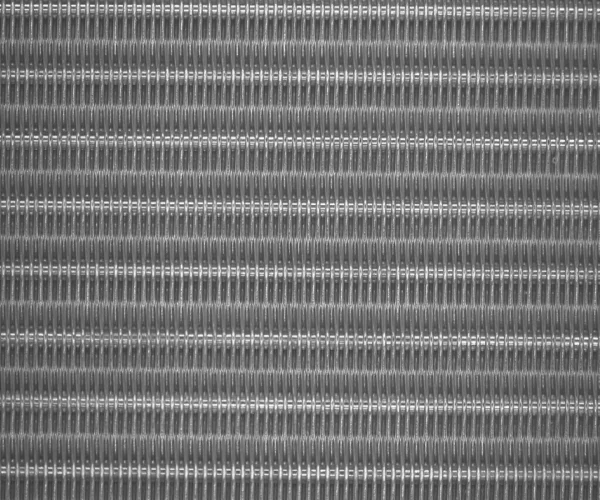
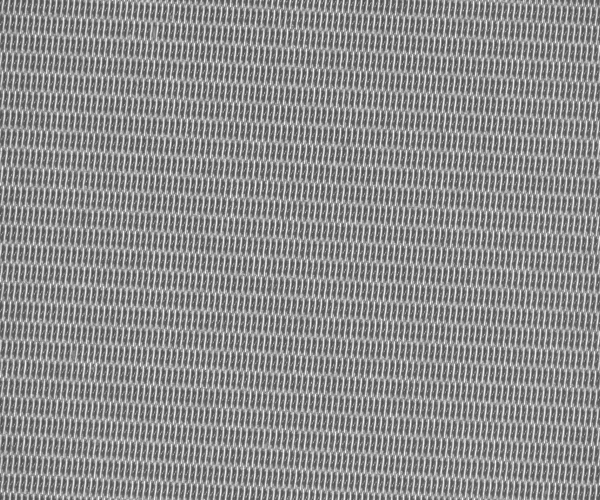
Weave close up 1 | Weave close up 2
Material. The published range lists SUS304, SUS316, copper, nickel and titanium; selected fine twill entries specify SUS316L. Confirm the exact alloy for the chosen construction.
Process duty. Provide polymer or fluid grade, throughput, viscosity at operating temperature, pressure and allowable differential pressure. Include the contamination concern and required product quality.
Mechanical support. Show the complete layer stack, support mesh, filter dimensions, edges and sealing arrangement. For belts, state the travel direction, width, tension and equipment reference.
Cleaning and supply. State cleaning chemicals and temperature, reuse or replacement cycle, current service history, material documentation, traceability and expected consumption.
Agree the Validation Method
Glass bead testing characterises the particles that can pass through a sample. Bubble point testing uses a wetted mesh and gas pressure to assess an equivalent maximum pore size.
Agree the method, acceptance limits and test conditions before comparing ratings.
Practical trial: compare pressure loss, run duration and downstream quality at matched process conditions. Record the inspection results and any change to the filter support or cleaning method.
Prepare Your Enquiry
What to Send Us.
Weave family; warp × weft counts; both wire diameters; alloy; rating and test method; dimensions; filter construction.
Discuss this product