
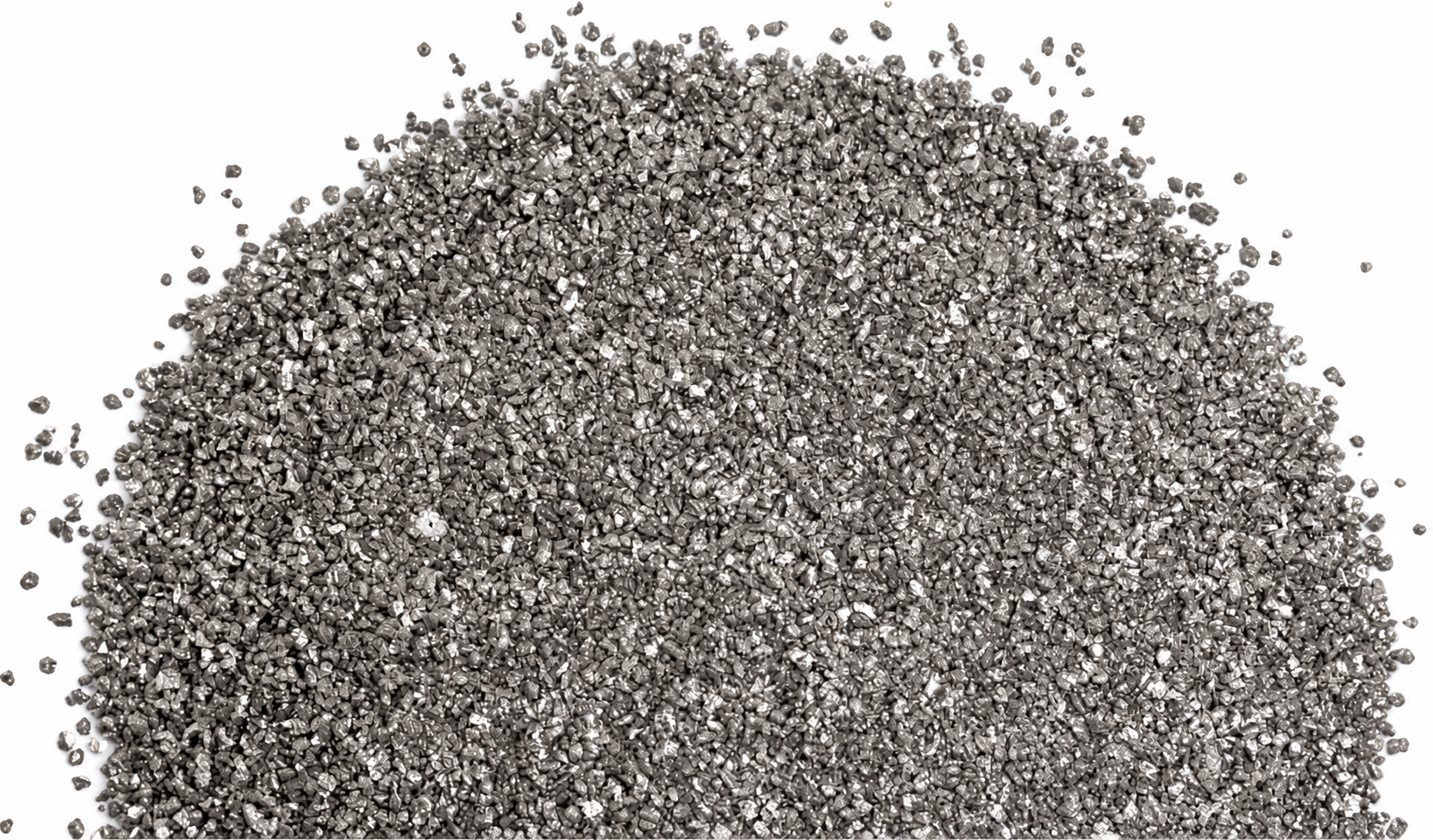
Application and Selection.
Selected by alloy, particle grading, bed depth and allowable pressure development. Coarse, medium and fine fractions can be combined to suit the spin pack arrangement.
- Alloy grades
- TF-01 · TF-03 · TF-04
- Particle fractions
- Eight fractions from 45 to 2000 μm
- Applications
- PET, rPET, PA6, PA66, PP and other thermoplastics
Technical Information
Open a section to view the details, tables and illustrations.
Product Overview
Depth Filtration Before the Spinneret
Protect the Spinneret through the Depth of the Filter Bed
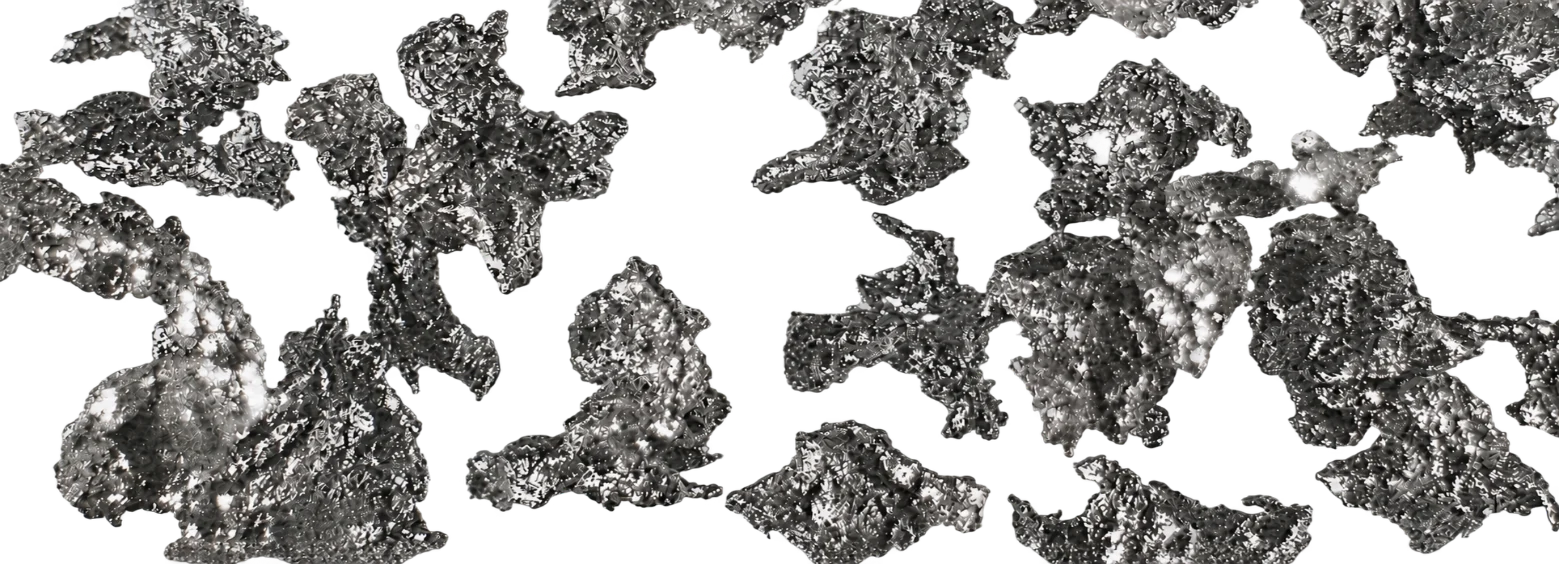
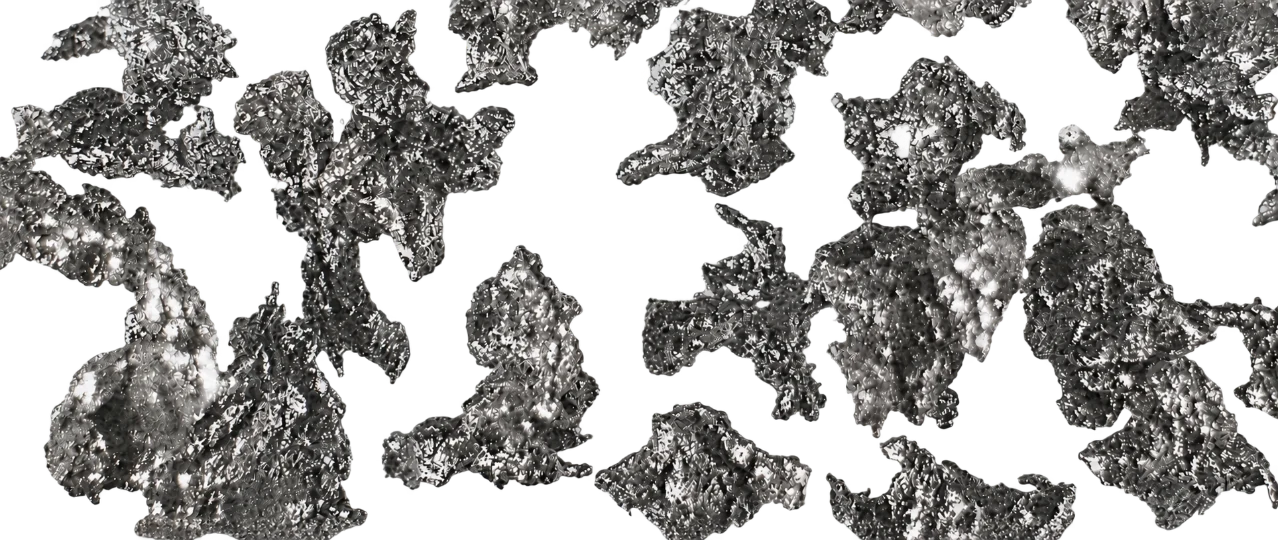
Irregular particles form a network of intricate flow paths within the packed bed, increasing the contact area for retaining contamination before the melt reaches the spinneret.
Representative Irregular Particle Morphology
Why Irregular Powder Is Used in Spin Packs
Polymer melts may contain hard solids from raw materials or equipment together with deformable gels.
If they reach the spinneret, contaminants can restrict capillaries and contribute to filament breaks, pressure instability and quality variation.
CAPTURE AND DIRT HOLDING: Textured particle surfaces provide a large contact area and a three dimensional retention path.
PRESSURE MANAGEMENT: A graded bed creates resistance to flow. Initial pressure and subsequent pressure rise depend on melt viscosity, throughput, bed depth, particle distribution, loading method and contamination accumulation.
PROCESS COMPATIBILITY: Alloy grade and particle blend must suit the polymer chemistry, melt temperature, preheating conditions and allowable differential pressure.
Product form: graded loose powder for a particulate filter bed - not a bonded or sintered porous disc, candle or element.
Application Scope
Suitable for validated packed bed spin pack duties in PET, rPET, PA6, PA66, polypropylene and other thermoplastic polymer processes.
POY and FDY filament spinning
BCF, IDY (industrial yarn) and staple fibre extrusion
Virgin and recycled polymer streams subject to process review
Controlled Production
Water Atomisation Creates the Irregular Morphology Required for Depth Filtration
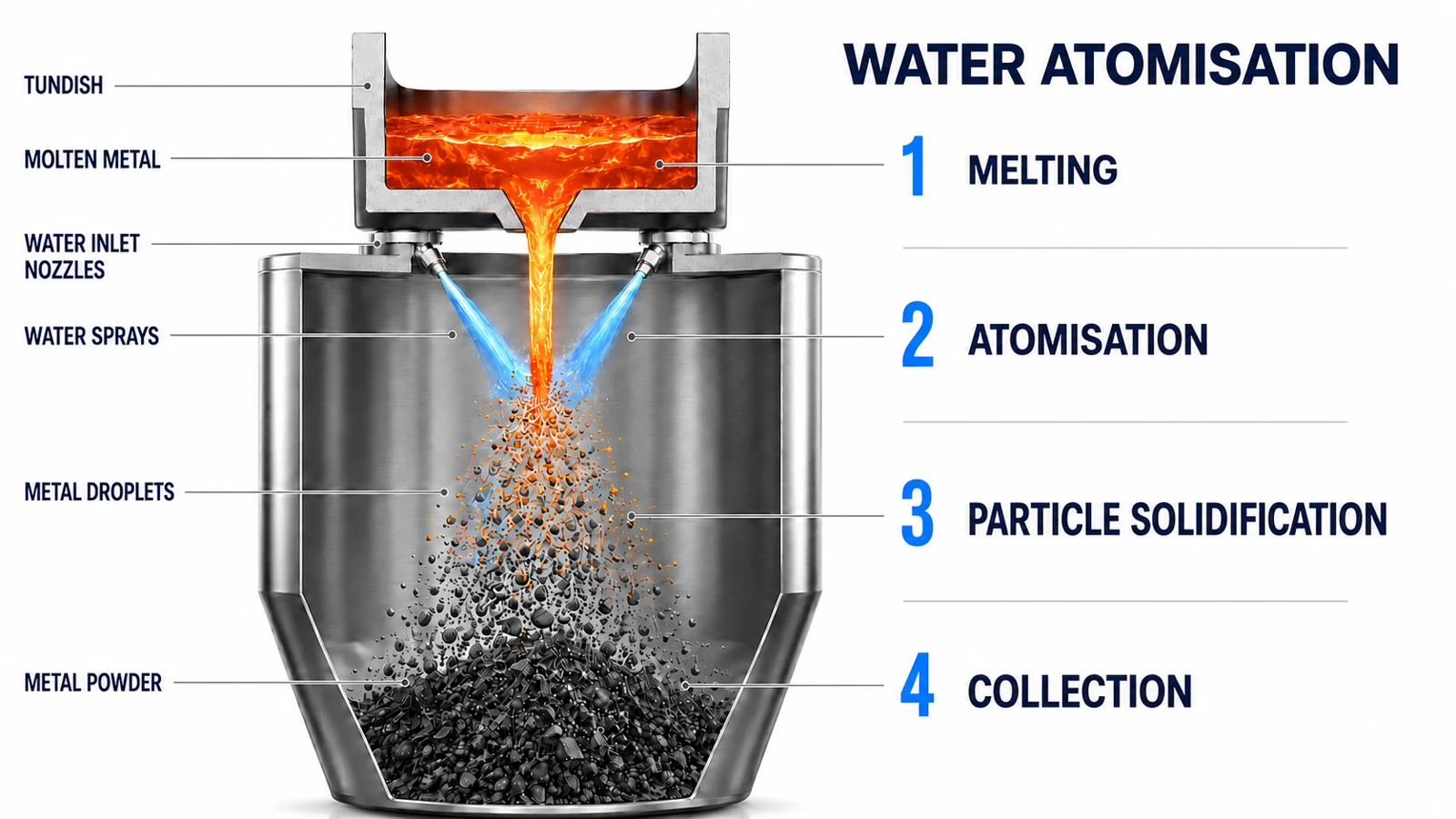
High velocity water jets disintegrate a controlled molten metal stream; the droplets cool, solidify, dry and are classified into defined size fractions.
Water atomisation process - representative production sequence
Process Sequence
MELTING: A controlled molten metal stream leaves the tundish.
ATOMISATION: High velocity water jets divide the stream into droplets.
SOLIDIFICATION: Rapid heat extraction solidifies the droplets during descent.
CLASSIFICATION: Powder is collected, dried, sieved and graded to specification.
OUTPUT: Irregular water atomised stainless steel powder in controlled size fractions, supplied against the approved product specification.
Typical Polymer Melt Spin Pack Assembly
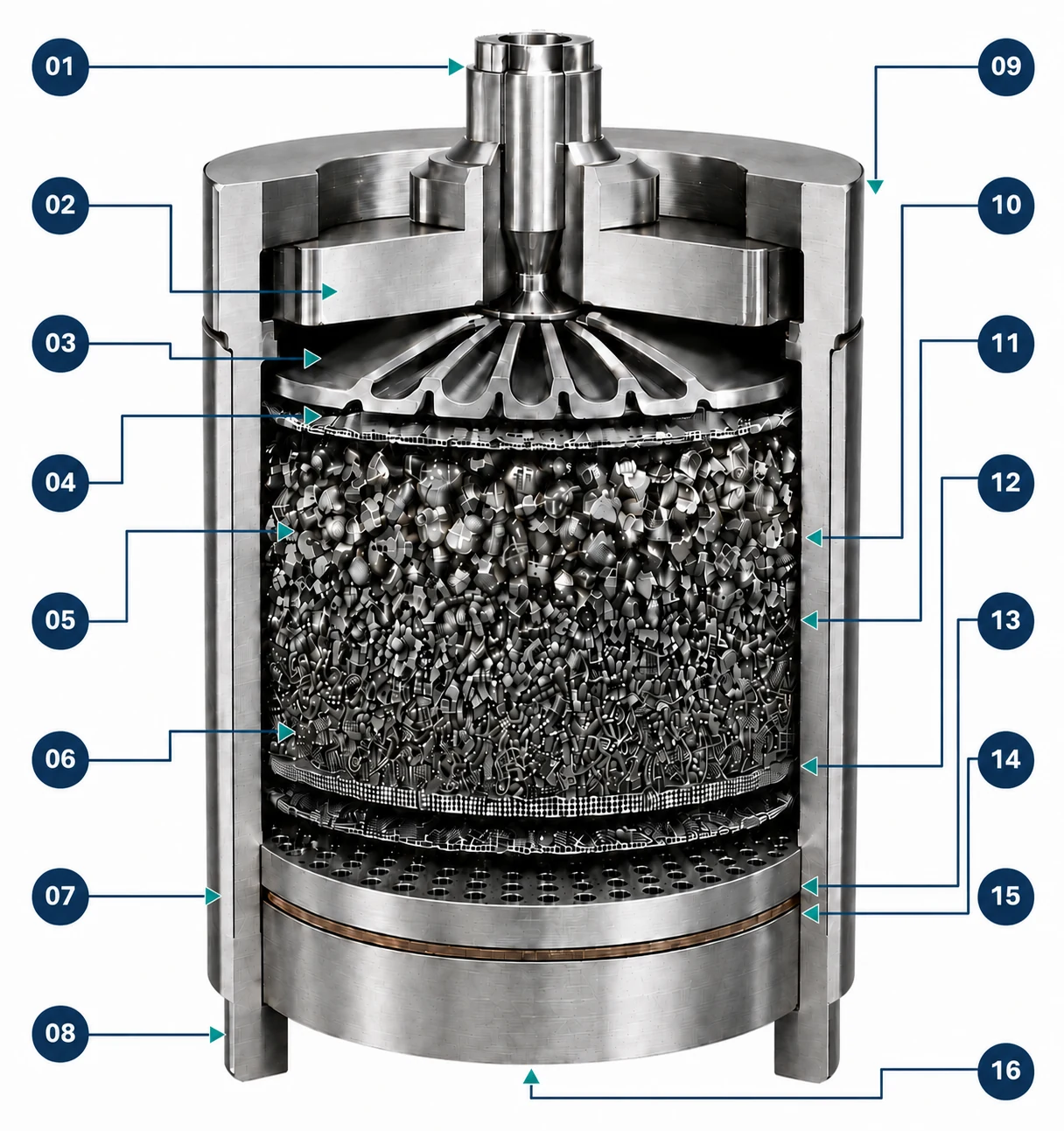
Component Names and Engineering Functions
No. | Component | Function |
|---|---|---|
1 | Polymer Melt Inlet | Receives metered polymer melt under pressure. |
2 | Pack Head / Top Cover | Closes the pack and applies axial compression to the internal stack. |
3 | Aluminium Crush Seal | Prevents high pressure melt leakage at the upper pack interface. |
4 | Flow Distribution Plate | Spreads the central inlet flow uniformly across the filter bed area. |
5 | Upper Retaining Screen | Contains and stabilises the loose metal powder bed. |
6 | Coarse Metal Powder Layer | Provides first stage depth filtration and high dirt loading capacity. |
7 | Medium Metal Powder Layer | Captures progressively smaller solids and gels. |
8 | Fine Metal Powder Layer | Provides final granular filtration and controlled melt shear. |
9 | Fine Retaining Screen | Prevents fine metal powder migration into downstream hardware. |
10 | Coarse Support Screens | Support the fine screen against differential pressure. |
11 | Breaker / Support Plate | Carries the packed bed and redistributes melt before the spinneret. |
12 | Spinneret Gasket | Seals the breaker plate to spinneret interface. |
13 | Spinneret Plate | Divides the melt into uniform vertical capillary streams. |
14 | Spinneret Holder / Clamp | Retains the lower assembly. |
15 | Spin Pack Body | Contains the complete pressurised filter stack. |
16 | Extruded Filaments | Uniform filaments exit the spinneret. |
ARRANGEMENT RESULT: The graded bed progressively captures solids and gels while distributing melt to the spinneret.
In a balanced pack, the spinneret produces parallel filaments with more consistent flow and reduced capillary contamination risk.
Important Design Points
Melt flows through the metal sand bed from coarse to medium to fine. This graded arrangement delays blockage and progressively increases filtration resistance.
Retaining mesh is required above and below the loose sand, with supporting screens and a breaker plate beneath it.
Modern packs typically include the inlet cover, sealing ring, flow guide, filter layers, distribution/breaker plate, spinneret and pressure housing.
Two or three powder grades are commonly used. Their particle sizes, quantities and bed depths must be selected for the polymer, viscosity, melt cleanliness, temperature and throughput.
This is a representative configuration; individual Barmag, Neumag, TMT and other OEM packs may combine or reposition some screens and distribution plates.
Effect on Filament Quality
A correctly engineered coarse to medium to fine metal sand bed provides progressive depth filtration and controlled melt flow resistance.
It removes gels and contaminants, protects spinneret capillaries and supports uniform melt distribution across the spinneret.
Potential Filament Quality Benefits
Improved yarn and filament linear density uniformity
Lower Decitex / Denier variation and Uster CV%
More consistent tenacity and elongation
Reduced contamination related variation; molecular orientation, shrinkage and dye uptake also depend on polymer and downstream processing
Fewer gels, slubs, broken filaments and spin breaks
Reduced fuzz, loops and downstream processing defects
More stable pack pressure and extended operating life
Average linear density and tensile properties remain primarily controlled by polymer quality, pump delivery, temperature, quenching, spinning speed and draw ratio.
Metal sand grades, quantities and bed depths must therefore be matched to the polymer and process.
Insufficient filtration allows contaminants and spinneret blockage, while excessive filtration resistance can cause high pressure, melt heating, polymer degradation and reduced pack life.
Alloy Selection
Select the Grade Around Polymer Chemistry, Temperature and Pressure Duty
Final approval requires a process review and confirmation against the current product specification and batch certificate of analysis.
Grade | Positioning | Typical Application Guidance |
|---|---|---|
TF-01 | Standard Media | PET POY / FDY applications where the approved specification meets the process duty. |
TF-03 | Intermediate Media | Higher mechanical strength and lower oxidation sensitivity for more demanding PET filtration duties. |
TF-04 | Higher Chromium Media | Higher initial pressure and compaction resistance duties, including validated PA filament applications. |
Chemical composition limits (mass %)
Grade | IronFe | NickelNi | ChromiumCr | MANGANESE Mn | SiliconSi | MOLYBDENUM Mo | CarbonC |
|---|---|---|---|---|---|---|---|
TF-01 | Balance | Max. 0.6 | 16 – 18 | Max. 1.0 | 1.0 - 4.0 | - | Max. 0.12 |
TF-03 | Balance | 6 – 12 | 16 – 22 | Max. 1.0 | 0.6 - 3.5 | Max. 3.0 | Max. 0.12 |
TF-04 | Balance | Max. 0.6 | 33 – 37 | Max. 1.0 | 2 - 4 | - | Max. 0.12 |
Grade selection considers polymer chemistry, pack preheating conditions, melt temperature, differential pressure, oxidation sensitivity and resistance to compaction.
SELECTION CONTROL: Validate initial pressure, pressure rise rate, polymer colour, filament performance and pack life under the actual operating conditions.
Particle Size Control
Build the Packed Bed from Controlled Coarse, Medium and Fine Fractions
The final blend depends on the retention target, bed depth, melt viscosity, throughput and allowable pressure drop.
PARTICLE SIZE RANGE (micron) | Nominal Mesh | APPARENT DENSITY (g/cm3) | TAP DENSITY (g/cm3) | Indicative Porosity (%) |
|---|---|---|---|---|
850 - 2000 | 10 / 20 | 1.45 | 1.95 | 75 |
500 - 850 | 20 / 30 | 1.55 | 2.10 | 73 |
350 - 500 | 30 / 40 | 1.60 | 2.10 | 71 |
250 - 350 | 40 / 60 | 1.65 | 2.60 | 67 |
180 - 250 | 60 / 80 | 1.80 | 2.70 | 65 |
125 - 180 | 80 / 120 | 2.10 | 3.00 | 60 |
90 - 125 | 120 / 170 | 2.30 | 3.10 | 58 |
45 - 90 | 170 / 325 | 2.40 | 3.20 | 56 |
Particle size fractions are determined by dry sieving in accordance with ISO 4497:2020 - Metallic powders: determination of particle size by dry sieving
Irregular morphology supports useful void volume and multiple flow paths through the packed bed.
IMPORTANT: Apparent density, tap density and porosity values are indicative supplier data.
Media Performance Is Proven in the Complete Spin Pack and Process
Particle strength, irregular morphology and controlled size fractions are designed to support stable filtration; actual results depend on the full pack architecture and operating conditions.
Media Characteristic | Intended Operating Effect |
|---|---|
High Mechanical Strength and Particle Integrity | Resistance to deformation and compaction as pack pressure rises. |
Irregular Surface With Comparatively Low Apparent Density | High contact area and useful void volume within the packed bed. |
Controlled Coarse, Medium And Fine Fractions | Tunable bed architecture, retention duty and pressure profile. |
TF-01, TF-03 And High Chromium TF-04 Options | Grade selection around polymer, thermal and oxidation duty. |
Recommended trial measurements
Initial pack pressure at stabilised throughput and melt temperature
Pressure rise rate during the agreed operating period
Pack life against the existing approved media
Filament breaks, yarn quality and spinneret cleanliness
Polymer colour and any evidence of oxidation or degradation
QUALIFICATION PRINCIPLE: Agree the product specification, trial quantity, operating window, measurable success criteria and review point before routine commercial supply.
Qualification links the approved media specification to measurable plant performance
Qualification through Controlled Trials
Agree the baseline media, trial quantity, operating window and acceptance criteria before routine supply. Compare like for like operating conditions.
| Record | Comparison basis |
|---|---|
| Initial pressure | Stabilised throughput and melt temperature; identify the pressure measurement point. |
| Pressure rise rate | Same units, time interval and polymer duty. |
| Pack life | Hours and processed mass, with the shutdown reason. |
| Filament quality | Breaks, linear density variation and relevant tensile or defect measurements. |
| Polymer condition | Colour and evidence of degradation or contamination. |
| Pack inspection | Spinneret cleanliness, screen condition, bypass evidence and bed condition. |
Upstream pack pressure is not necessarily the pressure drop across the powder bed. Record downstream pressure where available, and identify gauge, absolute or differential pressure.
Define the Application Before Selecting the Grade and Blend
Provide complete process, spin pack and operating data so our technical team can propose a controlled trial specification.
Information Required for Selection
Product and polymer: POY, FDY, BCF, industrial yarn, staple fibre or other extrusion duty
Throughput per spin pack and operating melt temperature
Spin pack cavity dimensions, available bed depth and screen arrangement
Spinneret diameter, capillary diameter and hole count
Current particle size blend, pack weight and loading method
Initial pressure, maximum permitted pressure and typical pack life
Target filtration improvement, yarn quality issue or contamination type
India - China Supply Partnership
Established Manufacturing and Global Reach
Established manufacturing capability in China since 2007 is supported by application expertise and commercial coordination in India. The stainless steel metal sand is accepted by major polymer spinners in China and international markets, with our wider filtration portfolio exported to more than 40 countries.
Competitive Technical Performance
Controlled particle sizing, irregular morphology and alloy options position the media as a credible alternative to established European and US products. Comparable or potentially improved performance can be confirmed through customer specific spin pack trials under agreed operating conditions.
Planned Surat – Silvassa Stock Programme
Selected approved grades and particle size ranges will be imported in consolidated quantities and stocked locally in Surat and Silvassa against agreed customer forecasts or blanket orders. Customers will be able to call off smaller quantities according to actual consumption instead of purchasing and storing a complete shipment.
Rapid Local Call Off Supply
Local dispatch from Surat and Silvassa will provide the shortest practical delivery time and a faster response to urgent or unplanned requirements. It will also reduce exposure to international freight schedules, customs clearance delays and costly emergency shipments.
Customer Inventory and Supply Benefits
The programme will reduce customer held inventory, working capital commitment and warehouse requirements. Scheduled call offs and planned stock replenishment will support reliable material availability, purchasing flexibility and continuity of production.
Prepare Your Enquiry
What to Send Us.
Polymer and grade; throughput per pack; melt temperature; pack drawing; current powder blend and bed depth; initial and terminal pressure; annual consumption.
Discuss this product